

Name:
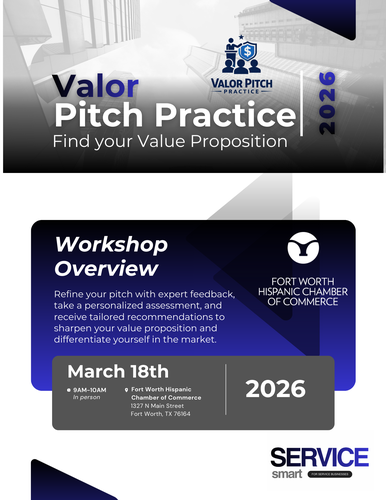
2026 Valor Pitch Practice
Date:
March 18, 2026
Time:
9:00 AM - 10:00 AM CDT
Event Description:
Valor Pitch Practice is a hands-on coaching session designed to help entrepreneurs refine their business pitch, strengthen their confidence, and clearly communicate their value proposition. Participants receive real-time feedback from experienced mentors, improve their storytelling, and sharpen their presentation skills to better compete for funding, customers, and growth opportunities. If you would like to present, use this link to book. Book time with Admin: Pitch Practice Participant
The 10–Slide Pitch Framework (Research-Backed)
This structure is adapted from the Guy Kawasaki 10/20/30 Rule, which is one of the most validated pitch models used by investors, accelerators, and pitch competitions globally. It aligns with research on cognitive load, storytelling, and decision-making under time pressure.
Why this framework works (research basis)
-
Humans retain stories better than data alone (Harvard Business Review)
-
Judges form initial conviction in the first 90 seconds
-
Simplicity increases persuasion and recall
-
Clear problem–solution alignment predicts funding outcomes more than financial depth alone (VC research)
Pitch Competition Structure (What to Say)
1. Problem (The Pain)
What real problem are you solving?
-
Who experiences it?
-
How often?
-
What happens if it’s not solved?
Judges look for urgency, not cleverness.
2. Customer (Who Feels the Pain)
Who specifically has this problem?
-
Be precise (not “everyone”)
-
Tie the problem to a real person or situation
3. Solution (Your Answer)
What do you do that fixes the problem?
-
Simple explanation
-
No jargon
-
One sentence if possible
4. Value Proposition (Why You)
Why is your solution better than existing options?
-
Faster, cheaper, safer, easier, or more reliable
-
What makes you different?
5. Market Opportunity
How big is the opportunity?
-
Size of market
-
Why now?
-
Why this matters economically
6. Business Model (How You Make Money)
How does money come in?
-
Who pays?
-
How often?
-
Pricing logic
7. Traction (Proof)
What evidence do you have?
-
Revenue
-
Customers
-
Partnerships
-
Pilots
-
Growth metrics
Traction doesn’t have to be big — it has to be real.
8. Competition
What alternatives exist today?
-
Direct competitors
-
Indirect substitutes
-
Why you still win
9. Team (Why You Can Execute)
Why are YOU the right people?
-
Relevant experience
-
Lived experience
-
Execution credibility
10. Ask (What You Need)
What are you asking for and why?
-
Funding amount
-
Use of funds
-
What success looks like next